


$49.99 /Monthly
Registration fee: $0.00


Live online sessions (Classroom)
10 students
50 min
Beginner
Internet
Fast internet speed required
Language
English, Urdu
Device
Mobile, Laptop, Tablet with zoom application installed.
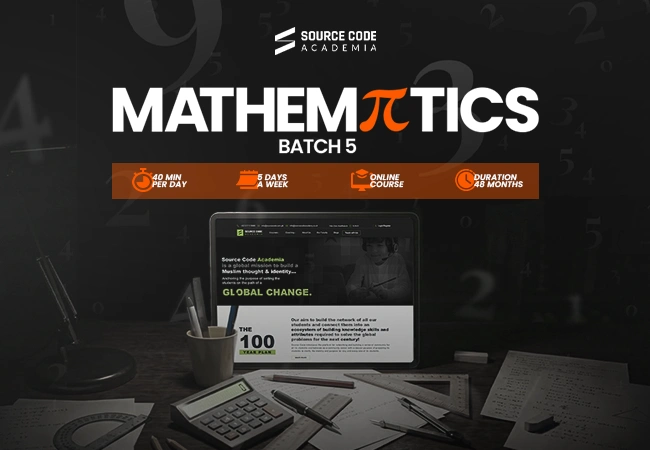
This 60-month mathematics course develops deep conceptual understanding and practical application skills from foundational arithmetic through basic to advanced topics using project-based learning integrated with Python coding & Quranic mathematical concepts & ideas.
Core Objectives:
This course is aligned with Source Code Academia's expertise pillar. Through this course, our goal is to transform students into confident mathematical thinkers who see mathematics as the foundational language of science, not merely abstract formulas. We prepare you to conquer core STEM subjects with competence and curiosity.
Let’s Get Enrolled in comprehensive mathematical mastery today!
Reserve your spot by registering him/her as a student on our platform. Complete the quick account setup process to access the enrollment system and begin your mathematics journey with Source Code Academia.
Fill in your personal & educational information, select a time slot comfortable for you from the available options, enter your payment card details securely, and process your registration payment to confirm your place in the course immediately.
View enrolled courses in the personalized student dashboard under "My Courses". Access all course materials, schedules, and resources from the student portal (or LMS) to begin your mathematics learning journey right away.
Our 3-Step Application Process
Reserve your spot by registering as a student on our platform. Complete the quick account setup to access the enrollment system and begin your learning journey.
Fill in your information, select a time slot that works for you, enter your payment details securely, and confirm your registration to secure your place in the course.
View your enrolled courses in the personalized student dashboard under "My Courses". Access all course materials, schedules, and resources from your student portal to get started right away.
$49.99 /Monthly
Registration fee: $0.00
$149.97 /Quarterly
Registration fee: $0.00
$599.88 /Yearly
Registration fee: $0.00
Support a deserving student by sponsoring their fees for this course. Your contribution helps someone learn, grow, and build a brighter future.
Cover course fees
Help a student complete this course without financial barriers.
Matched by need
Recipients are selected based on merit and financial need.
Meaningful impact
Your sponsorship directly opens access to quality education.

Lina Haque
Source Code Academia changed the way I see the world. The blend of Islamic knowledge and modern thinking is unlike anything I have ever experienced. My family noticed the difference immediately.

Ahmed Farooq
Within months of joining the Arabic course, I was reading Quranic texts with genuine understanding. The structure is brilliant, the teachers are patient, and the results speak for themselves.
Sara Malik
Sahil Adeem's coaching gave me a business framework I use every single day. Not just theory — real, applicable strategy with an Islamic perspective I couldn't find elsewhere.
Hamza Ali
My children are more articulate, more grounded, and more confident. This institution does not just teach — it transforms. I wish I had access to this education when I was growing up.
Fatima Naseer
The STEM programme is world-class. Taught in English, aligned with international standards, and grounded in an Islamic environment. Exactly what Muslim students in Pakistan need.
Fatima Malik
Before joining Source Code Academia, I had knowledge scattered across different teachers and books — but no foundation. This course didn't just give me information, it gave me a structure. I now understand why I believe what I believe, and I can articulate it with confidence. The teaching style here is unlike anything I've experienced. It reaches something deep.
Lina Haque
Source Code Academia changed the way I see the world. The blend of Islamic knowledge and modern thinking is unlike anything I have ever experienced. My family noticed the difference immediately.
Ahmed Farooq
Within months of joining the Arabic course, I was reading Quranic texts with genuine understanding. The structure is brilliant, the teachers are patient, and the results speak for themselves.
Sara Malik
Sahil Adeem's coaching gave me a business framework I use every single day. Not just theory — real, applicable strategy with an Islamic perspective I couldn't find elsewhere.
Hamza Ali
My children are more articulate, more grounded, and more confident. This institution does not just teach — it transforms. I wish I had access to this education when I was growing up.
Fatima Naseer
The STEM programme is world-class. Taught in English, aligned with international standards, and grounded in an Islamic environment. Exactly what Muslim students in Pakistan need.
Fatima Malik
Before joining Source Code Academia, I had knowledge scattered across different teachers and books — but no foundation. This course didn't just give me information, it gave me a structure. I now understand why I believe what I believe, and I can articulate it with confidence. The teaching style here is unlike anything I've experienced. It reaches something deep.
Did not find the answer here? Contact our help and support team.
This course has been launched.
This program is tailored for learners seeking to build a robust foundation in mathematical logic and problem-solving. It is ideal for:
Registration is open to all individuals committed to academic growth. Participants should be 18 years old or above, along with a basic level of literacy to navigate the Learning Management System (LMS) effectively. For any minor participants, a legal guardian must facilitate the registration process and oversee platform usage to ensure a productive learning environment.
To ensure maximum retention without cognitive fatigue, our sessions are structured as 45-minute intensive modules. The program spans a comprehensive duration designed to move learners through four distinct levels of mathematical proficiency. Classes are held on a consistent weekly schedule to help students develop a disciplined study habit and maintain steady momentum.
Our curriculum is built on the philosophy that mathematical skill is a learned discipline, not an innate talent. We start with fundamental principles, ensuring no gaps in your knowledge. With a low student-to-instructor ratio and dual-language instructional support, we create a non-intimidating environment where complex concepts are broken down into digestible, logical steps.
We move beyond passive listening by utilizing an inquiry-based learning model. Our sessions incorporate:
To participate, you will need a stable internet connection and a compatible device (desktop, laptop, or tablet). We utilize the Zoom application for live sessions, so please ensure it is installed and updated. A digital stylus or tablet is recommended but not mandatory for participating in whiteboard exercises.
No prior specialized knowledge is necessary. This course is designed to accommodate absolute beginners as well as those looking to refresh their foundational knowledge. We begin with core concepts and systematically progress to more complex topics.
We offer a flexible, subscription-based payment model to make high-quality education accessible. You can secure your seat by paying for the first month during the enrollment period. For your convenience, we also provide:
Yes, the program is entirely location-independent. As long as you have a reliable internet connection and access to the necessary software, you can join our live interactive sessions from any time zone in the world.
This is a fully digital learning experience. All lectures, interactive workshops, and resource materials are delivered through our online learning platform, allowing you to master mathematics from the comfort of your home or office.
Our refund policy is structured as follows:
We facilitate payments via all major credit cards, debit cards, and direct bank transfers. If you require an alternative payment arrangement or a customized invoice for corporate reimbursement, please contact our support team at +92 317 1119981 to discuss your requirements.
Yes. Upon successful completion of all modules, assessments, and final projects, you will be awarded an official Certificate of Mathematical Proficiency, which can be used to bolster your academic portfolio or professional resume.